
Finding Your Leadership Balance: A More Sustainable Way to Lead

Phew!!! There is a LOT swirling around in the world right now. And all that’s happening - much of it out of our immediate control - adds to the already intense pressure leaders face every day. Between constant change initiatives, uncertainty, noise, and the everyday demands of work and life, many leaders are carrying far more than they were ever meant to carry alone.
In moments like these, the instinct is often to push harder, move faster, and try to hold everything together. But sustainable leadership doesn’t come from overextending yourself. It comes from learning how to stay grounded when things around you feel unsettled. Finding balance isn’t about stepping away from leadership responsibilities; it’s about leading with greater clarity, intention, steadiness, and self-awareness so you can continue showing up well for the people who rely on you.
Why Balance Matters
We say this all the time, but it’s true: as a leader, you set the tone for your team. You may not be sending messages intentionally, but your mindset, energy, and presence affect the people around you. If you’re scattered and feeling drained, then your team will feel it. If you’re thoughtful, grounded, and intentional, they’ll feel that too. Makes sense, right?
Have you ever heard of sustainable leadership? Sustainable leadership isn’t about doing less, but it’s about leading in a way that allows you to keep showing up well over time. Sustainable leadership is about boundaries. It’s about making room for reflection, relationships, and recovery so you have real presence and staying power. It means you know how to stay anchored when things around you feel uncertain.
Focus on What You Can Control
A quick online search can give you tools to sort through uncertainty. One of our favorites is from a book published decades ago that still resonates. Stephen Covey’s principles are as valid today as when they were first published. That’s the way it is with true wisdom: it lasts.
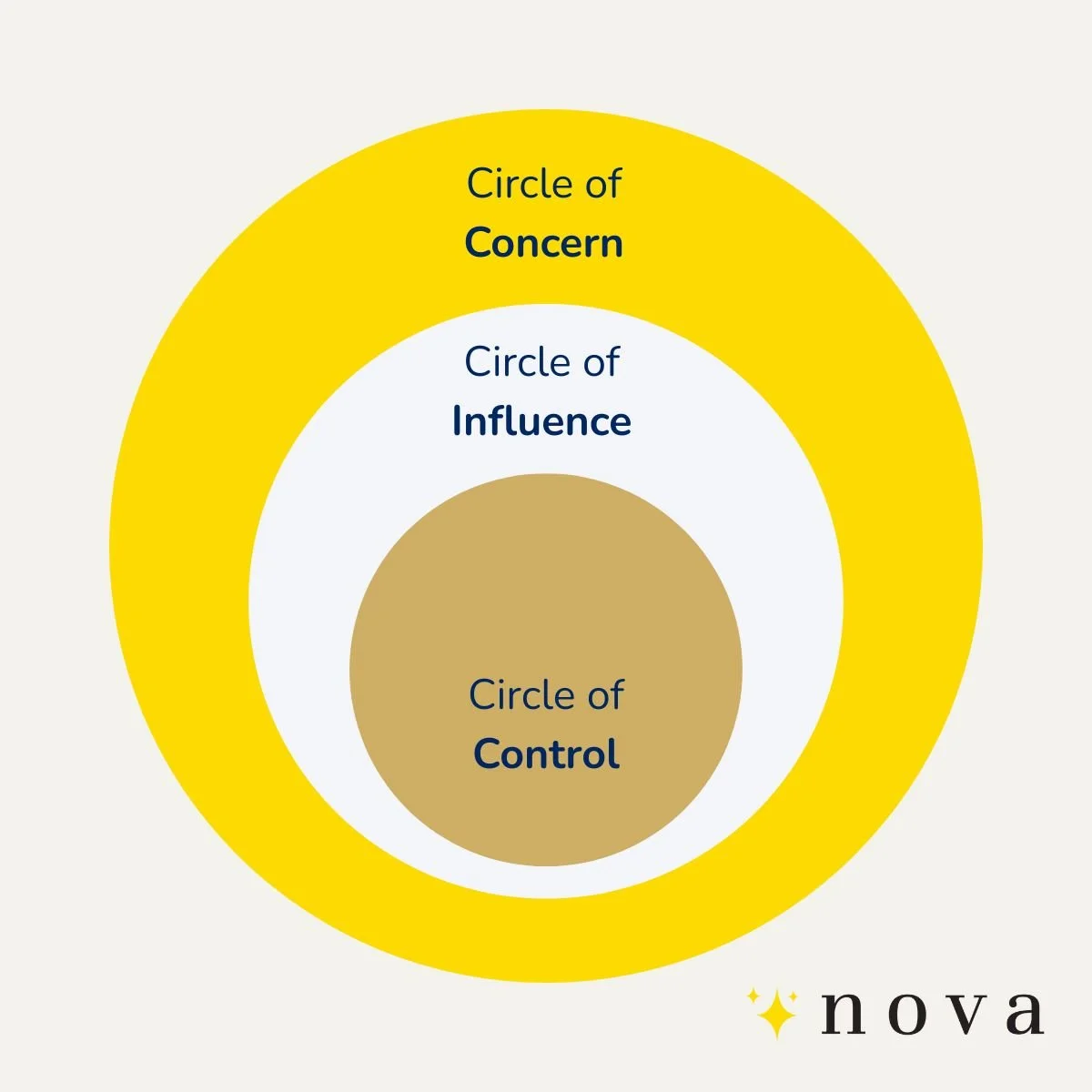
If you’re seeking balance and looking to help others do the same, look no further than Covey’s work around the Circle of Concern, Circle of Influence, and Circle of Control. The idea is that we can spend SO much energy worrying about things we cannot directly change, and becoming a wise leader starts by focusing on what we can influence and control.
You may have a lot in your circle of concern right now - it;s hard not to: there’s a lot to be concerned about. Know that these are not yours to carry all by yourself! Try sorting out what’s in front of you into three buckets:
Concern: things that do matter, but are mostly outside your control
Influence: areas where your voice, relationships, and actions can make a meaningful difference
Control: you: how you respond, where you place your attention, how you communicate, and how you care for yourself
Start with what you can control. Do you need to spend time doomscrolling? Would your time be better spent connecting with a friend, or maybe even taking a walk by yourself?
Consider where you do have influence. We can’t change the world by ourselves, but can you take one small action today that’ll make a difference? Can you find an opportunity to serve your community? Engage in a meaningful dialogue with people who may have a different point of view? Leverage your time, your voice, your relationships for good. Take a moment to practice gratitude. It’ll change your outlook.
While these may sound like small actions, they can make a huge difference. When you stop spending energy focusing on what you cannot fix, you create more room for what you actually can shape. And that’s both meaningful and valuable!
We’re Meant to Be in Community
Leadership can feel lonely, especially when everyone is looking to you for answers, and we’re not meant to do this alone. In stressful seasons, meaningful connections are part of what helps us stay resilient. The APA’s study on Stress in America 2025 report emphasizes how deep connection and community matter. Community helps leaders:
Regain perspective
Feel less alone in hard decisions
Process complexity out loud
Remember what matters
Build resilience over time
That is why we promote shared learning and real connection. Our Mastermind groupscreate space for leaders to grow alongside others who understand - and struggle with - the weight of leadership. Our Retreats offer time to step away from the noise, reset, and come back with a fresh perspective. For more on community, check out the former blog post: Building a Strategic Community of Women, which you can view here
Work Life Balance for Leaders
Leaders tend to think that more is better. Do more. Accomplish more. Drive more. No! Rest is part of being a good leader. When your role calls for you to be responsive, thoughtful, and emotionally steady, you can’t run on empty and expect to lead at your best. This is wherework-life balance for leadersbecomes critical. It might look like:
Taking an actual break for lunch
Blocking thinking time on your calendar
Being able to say no if it doesn’t align with your values
Asking for help instead of pushing through alone
Stepping away long enough to hear yourself think again
It’s not selfish to incorporate these things; it’s strategic.
Executive Leadership Coaching
Balanced leadership looks like clarity over urgency, reflection over reaction, and support over isolation. It also looks like being willing to ask for help when you need it. That’s why executive leadership coaching can be so valuable. We give leaders space to think clearly, challenge assumptions, and reconnect with what matters most.
In a season where so much feels outside your control, you can choose how you lead. You can focus on what is yours to shape, lean into the tools (and people!) who help you stay grounded, and create space to lead with steadiness, clarity, and courage.
And if you are ready for deeper support, this may be the right time to join one of our Nova Mastermind groups or step away for aretreat experience in Italy! Sometimes the most powerful next step is not doing more - it’s finding the support, perspective, and balance you need to lead well for the long haul.