
Beyond the Mentorship Myths: How Two-Way Learning Builds Stronger Leaders

How would you define mentorship? We find that people view it differently, and there are some common misconceptions about what mentorship should look like. In this blog, we’re breaking down five of these myths - and outlining how mutual accountability can help create stronger, more balanced mentor-mentee relationships.
A strong mentor relationship isn’t just one person giving advice while the other person is taking notes, and trying to soak in and learn as much as they possibly can. Mentorship is a two-way exchange where both people can grow and learn.
Harvard Business Review says: “The best mentorships help both people grow.” While it sounds super simple, this idea is the entire basis of effective mentoring. Sure, a mentor can often bring years of experience and guidance, but the mentee also brings new ideas, lots of questions, and a different way of seeing things that the mentor may not have thought of before. When both people show up ready to learn, the relationship becomes much more powerful.
So - how can things get misconstrued? Let’s explore!
Myth #1: Mentors Do All the Teaching
In our experience, this is one of the biggest misconceptions around mentorships. People tend to think of mentorship as a “take” relationship (what can the mentee learn from the mentor), but the best mentor/mentee relationships are two-way. Think about all the ways you, as a mentee, can partner with your mentor to:
Look at challenges from a different angle
Bring the perspective of a different audience/generation/functional group
Explore new technology, tools, or trends
Reconnect with the questions that shaped their own leadership journey, and the why of their work: so important to have this connection!
Mentorship in leadership development creates space for both people to reflect, stretch, and grow.
Myth #2: My Mentor Has to Be Older
Not always! Your mentor should be someone you can learn from - and share ideas with. Maybe it’s someone who has a certain skill you’d like to learn. Maybe it’s someone who’s lived or worked in a country with which you do business regularly. Maybe it’s someone who’s made a career of a hobby that you enjoy, and you want to explore the same.
UMass Global says, “Most traditional workplace mentoring relationships involve senior employees helping guide the personal and professional growth of more junior colleagues. But age and organizational hierarchy aren’t necessarily the most important factors in today’s increasingly multigenerational workforce.” And we agree!
Myth #3: My Mentor Should Have a Similar Career Path
Not necessarily. A similar background can be helpful, but it’s not required. In fact, some of the deepest learning can happen when two people bring completely different experiences to the table.
What could an engineer learn from an artist?
What could an attorney learn from a nonprofit CEO?
What could a finance executive learn from a sales leader?
Different career paths can challenge your assumptions and expand your thinking. If the goal is growth and expanding your perspective, then different is a good thing.
Myth #4: My Mentor Needs to Come From a Successful Corporation
A corporate executive may be the right mentor if your goal is to move into the C-suite. But that’s not the only wisdom worth seeking.
You may want to learn from an entrepreneur, a writer, an artist, a coach, a community leader, or someone who is living a life of courage and intention. There is INCREDIBLE untapped wisdom in the world, and we find it when we are willing to invest in meaningful one-on-one relationships.
Myth #5: Mentorship Is a Time Drain
Mentorship does take time, but it doesn’t have to take over your calendar. The best mentoring relationships are clear, intentional, and mutually valuable.
Maybe you need a mentor for the next 60 days to help with a project. Maybe you want more sustained career guidance over the course of six months or a year.
Before you begin, talk through:
What do we both hope to gain from this?
How often should we meet?
How long should this mentoring relationship last?
What does success look like for each of us?
Get clear on the objectives for your mentoring relationship, and it will be time well spent for both of you.
What’s in It for You?
If you’re exploring leadership mentorship strategies, here are a few benefits worth considering:
Stronger relationships and a wider network
Expand your thinking and gain a fresh perspective
You’ll have access to a trusted sounding board
Better communication skills
More confidence in your leadership decisions
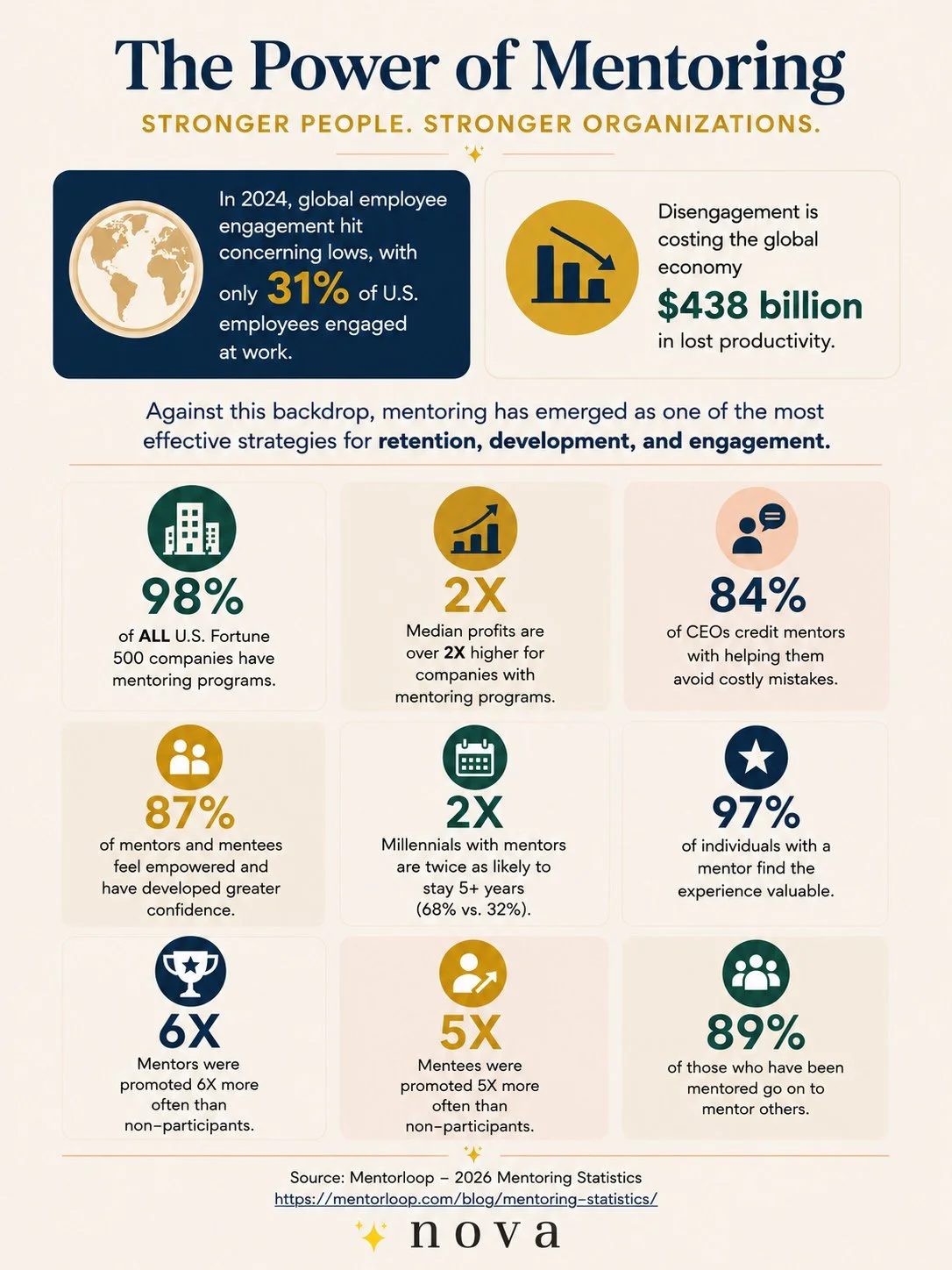
An added bonus is that mentoring also benefits organizations. Mentorloop reports that 83% of Gen Z workers believe workplace mentors are important, while only 52% have one. That gap points to a real opportunity for leaders and companies to create more intentional mentoring connections.
At Nova Leadership, we also understand that mentorship is one of many places leaders can go for inspiration, especially when looking for a new perspective. You can learn more about this topic in one of our past blog posts on where to go for inspiration as a leader.
Executive Leadership Coaching
Just because you are a mentor, it doesn’t automatically mean you have all of the answers. Mentorship is about staying open to learn from the people around you. For us, building stronger leadership through mentorship starts with understanding that the best mentor relationships are two-way streets. They are shared commitments to growth.
At Nova, we help leaders get clear on what matters most and redefine their path to purpose. We’d love to work with you. Reach out to learn more.